Key Trends Reshaping Contemporary Urban Planning
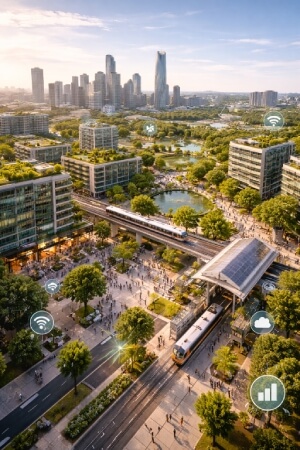
A variety of forces are coming together to help redefine the way in which cities are designed, governed, and experienced. Rapid urbanization, energy decarbonization targets, and the aging of baby boomers all demand that planners follow what once was an ideal approach, yet is now simply seen as being operational.
The new urban compact mixed-use development featuring green building techniques is the gateway for sustainable urbanism, lessening dependence on vehicles, shortening commute distances, and concentrating economic activity within spaces that are friendly to inhabitants and municipal budgets. Transit-oriented development is also primarily based on the proximity of transportation infrastructure to dense development patterns. The most well-known example of an influence of transport infrastructure on land development at a metropolitan scale is the finger plan of Copenhagen with dense development along rail corridors radiating outwards from the city center.
Smart cities are taking a step forward from sensor networks and traffic control. Virtual Singapore, which is being developed in Singapore, unites real-time information for energy sources, mobility, and public amenities for planners who are not only able to make crucial infrastructure decisions ahead of their being made but are, in this sense, utilizing public resources. Such governance, influenced by data analytics, becomes increasingly appealing for cash-strapped cities.
Planning Strategies That Improve Urban Resilience and Equity
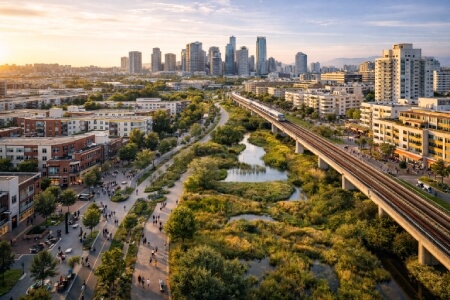
There's a substantial case to back up a little co-planning of land-use and transportation as one of the most evidenced ways of reducing car dependence and spatial inequity. As more cities become like Copenhagen, illustrating how well-designed transit corridors sit in mixed-use zones and gather services where people live, it is possible to reduce travel times and cut transport emissions at the same time. It is, though, quite a proportion of the larger metropolitan region operating on fragmented systems with different institutional mandates in place, transportation departments, housing authorities, and town planners lack interaction and funding.
Oddly, affordable housing presents a very similar governance failure. In response to climate adaptation investments, property values amplify inequality, and low-income populations are frequently displaced before they can benefit. While nature-based solutions like urban wetlands and green corridors are increasingly incorporated into city structures, their distribution currently mostly serves wealthier communities unless explicitly mentioned in tendering criteria.
Sustainable Cities Depend on Integrated Long-Term Planning
All arguments from varied cities like those in Singapore, Copenhagen, and Medellín do demonstrate that sustainability is not a sum of isolated actions. Where environmental goals, public transportation, affordable housing, and digital urban governance are designed independently from one another, performance across health, equity, and climate resilience is consistently weaker. The capacity to govern counts as much as design desire. Too often, a beautifully formulated master plan tends to be incoherent because it lacks coordination or community accountability. The real cost of uncoordinated planning is the slow but steady disintegration of the world's cities; an urban population that might bankrupt the world at only 68 percent of 2050 global total with unimaginable climate stresses generated themselves and around every coastal zone or nearby arid lands of today. What one knows now is that concerted action and long-term thinking is not just a performance goal for which only rich cities have the resources; it is actually the sine qua non for any city that has a desire to air well in the years to come.
UMUAHIA URBAN RENEWAL AND BEAUTIFICATION CONTINUES BY ABSG
— New Abia (@GreatAbia) March 24, 2026
The Commissioner of Information, Prince Okey Kanu, has stated that the state government has thought it wise to install speed bumps on some of the newly constructed roads, roadside tree planting, landscaping of designated pic.twitter.com/Wf7orqHXtd
Undoing the damage of sweeping mid-century urban renewal on the near south side really ought to be a goal of this city. And I don't think mega projects are the answer here... https://t.co/m8bWFFA4Dd pic.twitter.com/TYV7dHkDCr
— Midwest Antiquarian (@Eric_Erins) April 2, 2026