Curitiba, Brazil: Integrated Transit and Land-Use Coordination
By the 1960s, Curitiba faced the same pressures confronting most Latin American cities: rapid rural-to-urban migration, sprawling informal settlements, and an infrastructure budget nowhere near adequate to match the pace of growth. Rather than pursue a costly metro system, planners under architect Jaime Lerner introduced bus rapid transit along five structural corridors, then deliberately concentrated high-density zoning along those same axes. The logic was straightforward - density generates ridership, and ridership justifies frequency.
Some 70 percent of trips per day were made by transit in the 1990s - an essentially extraordinary figure for a city of its income level. Operational costs remained at much below metro standards.
Copenhagen, Denmark: Public Realm Design as a Mobility Strategy
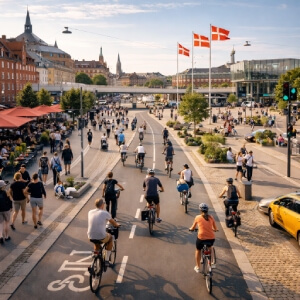
Street reallocation, not technology, drove Copenhagen's transformation. Beginning in the 1960s and accelerating through the 1990s, the city systematically converted car lanes and parking into cycling infrastructure and pedestrianized public space. By 2019, cycling accounted for 62% of all commuter trips - a figure sustained by a network exceeding 390 kilometers of protected lanes connecting residential neighborhoods directly to workplaces, schools, and transit hubs.
The planning logic treated accessibility, safety, and emissions reduction as inseparable objectives rather than competing priorities. Intersections were redesigned with cyclist sight lines and signal timing as primary considerations. Public squares like Superkilen were reimagined as active daily infrastructure, not decorative amenity.
Governance continuity proved equally significant. Successive municipal administrations maintained the same directional policy across decades, allowing iterative design testing - small interventions evaluated, refined, then scaled - to compound into system-wide behavioral change.
Singapore: State-Led Density, Housing, and Infrastructure Integration
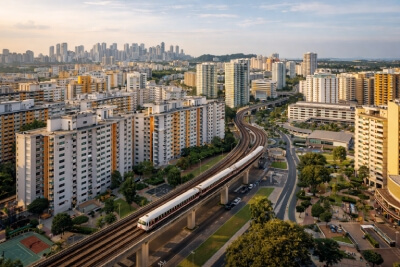
Singapore is one of the few locals where housing, transit, and land use have been planned together so systematically. The government was able to build over a million units of public housing by the 1980s simply due to its Housing Development Board, which housed nearly 80% of the population in purpose-built new towns such as Tampines and Woodlands. Each town was zoned for MRT stations with retail, schools, and jobs so the height of distance might be kept to low.
Across Singapore, Medellín, and Seoul, the transferable principles are integrated planning authority, sequenced investment, and measurable feedback mechanisms. Political context shapes what adapts elsewhere. Strong state capacity cannot simply be replicated, but the institutional logic behind each intervention can inform governance reform in cities with more fragmented systems.
Successful Cities Translate Vision Into Coordinated Delivery
The real worth of long-standing city development over short-term reform often lies less in the ambition of the original paper in case studies, but in the matching of a city with a particular, well-defined problem. The study examines the unique governance and design responses in each matching case and how these have been sustained over perhaps four decades. No model guarantees or results in a universally applicable answer. It demonstrates how land uses, mobility, housing, public space, and institutional capacities have to be aligned simultaneously, and not against one another. When one considers similar cases, it is best to think not about what made them gain public and political support but rather what makes the step-by-step logic behind them work: Who were the accountable institutions? What were the metrics to check progress? And under what political and financial circumstances can one hope for positive results? Transferability will always depend on these circumstances, not on interventions themselves.
UMUAHIA URBAN RENEWAL AND BEAUTIFICATION CONTINUES BY ABSG
— New Abia (@GreatAbia) March 24, 2026
The Commissioner of Information, Prince Okey Kanu, has stated that the state government has thought it wise to install speed bumps on some of the newly constructed roads, roadside tree planting, landscaping of designated pic.twitter.com/Wf7orqHXtd
Undoing the damage of sweeping mid-century urban renewal on the near south side really ought to be a goal of this city. And I don't think mega projects are the answer here... https://t.co/m8bWFFA4Dd pic.twitter.com/TYV7dHkDCr
— Midwest Antiquarian (@Eric_Erins) April 2, 2026